
Vernellia R. Randall, Weekly Racial Justice Briefing — May 18–24, 2026
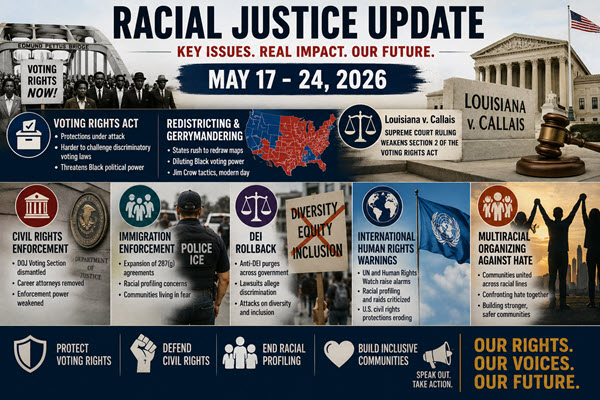
This week’s racial justice developments extended beyond voting-rights litigation into anti-DEI enforcement, hate crimes, immigration profiling, police accountability, and grassroots resistance movements. The dominant theme remained the accelerating rollback of race-conscious civil-rights protections alongside growing public mobilization against those changes.
Table of Contents
- Supreme Court Fallout and Voting Rights
- Mass Voting Rights Rally in Mississippi
- Anti-DEI Enforcement Expands
- Immigration Crackdowns and Racial Profiling Concerns
- Hate Crimes and Extremist Violence
- Police Accountability and Racial Disparities
- International Human Rights Warnings About the United States
- Emerging Research on Online Hate and AI Bias
- Bottom Line
1. Supreme Court Fallout and Voting Rights
The continuing impact of Louisiana v. Callais remained the most significant racial justice issue this week. Civil-rights groups warned that the decision sharply weakened Section 2 of the Voting Rights Act and could trigger new racial gerrymandering efforts across Southern states including Tennessee, Mississippi, Alabama, and Florida.
Advocates argue the Court is increasingly treating race-conscious remedies themselves as unconstitutional rather than addressing racial discrimination.
Why It Matters
The decision could reshape Black political representation in the South for decades.
Sources
- Brennan Center for Justice — “Finishing the Voting Rights Act: Supreme Court Declares Racism Over, Again” (May 2026) (Date Last Visited: May 25, 2026)
- Wikipedia — “2026 Tennessee Redistricting” (2026) (Date Last Visited: May 25, 2026)
2. Mass Voting Rights Rally in Mississippi
Thousands gathered in Jackson, Mississippi, this week to protest what organizers called a “return toward Jim Crow” after the Supreme Court weakened voting-rights protections.
The coalition included the NAACP, Fair Fight Action, Mississippi Votes, clergy groups, and student activists. Marchers retraced historic civil-rights routes while warning that racial vote dilution threatens Black political representation throughout the South.
Why It Matters
The protests demonstrate that modern voting-rights battles are increasingly being framed as a continuation of earlier struggles against Jim Crow disenfranchisement.
Sources
- The Guardian — “‘We Will Not Go Back to Jim Crow’: Thousands Rally in Mississippi for Voting Rights” (May 20, 2026) (Date Last Visited: May 25, 2026)
3. Anti-DEI Enforcement Expands
The Equal Employment Opportunity Commission filed a lawsuit against The New York Times alleging that its diversity, equity, and inclusion initiatives discriminated against white male employees.
Civil-rights advocates warned that the lawsuit reflects a broader federal strategy to dismantle DEI efforts in employment, higher education, and government contracting.
Why It Matters
The legal theory increasingly advanced by conservative officials reframes diversity initiatives as unlawful discrimination against white employees. Critics argue this approach weaponizes civil-rights law against remedial equity efforts.
Sources
- EEOC — “EEOC Sues The New York Times for DEI-Related Race and Sex Discrimination” (2026) (Date Last Visited: May 25, 2026)
4. Immigration Crackdowns and Racial Profiling Concerns
International human-rights officials and immigrant-rights groups continued warning that current immigration enforcement practices are increasing racial profiling against Latino and immigrant communities.
The United Nations Committee on the Elimination of Racial Discrimination criticized racialized immigration rhetoric, enforcement near schools and hospitals, and expanded detention practices.
Why It Matters
Advocates argue that immigration enforcement increasingly relies on ethnicity, language, accent, and neighborhood demographics as proxies for suspicion.
Sources
- United Nations OHCHR — “Racial Profiling and Racist Hate Speech by Political Leaders Heightened Human Rights Violations” (March 2026) (Date Last Visited: May 25, 2026)
- Human Rights Watch — “Trump’s Policing Policies Threaten Human Rights” (May 27, 2025) (Date Last Visited: May 25, 2026)
5. Hate Crimes and Extremist Violence
Federal authorities continued announcing prosecutions involving racially and religiously motivated violence. Recent cases included attacks targeting Black churches, threats against Sikh organizations, assaults on Asian Americans, antisemitic attacks, and white supremacist extremist activity.
Separately, the deadly shooting at the Islamic Center of San Diego intensified concerns about anti-Muslim violence and extremist rhetoric.
Why It Matters
Civil-rights groups warn that online extremism, white nationalism, antisemitism, anti-Black racism, Islamophobia, and anti-immigrant rhetoric continue fueling real-world violence.
Sources
- U.S. Department of Justice — Hate Crimes News (2026) (Date Last Visited: May 25, 2026)
- U.S. Department of Justice — Hate Crimes Portal (2026) (Date Last Visited: May 25, 2026)
- The Guardian — Trump Live Coverage Including San Diego Hate Crime Investigation (May 18, 2026) (Date Last Visited: May 25, 2026)
6. Police Accountability and Racial Disparities
New academic research released this week examined racial disparities in police use of force using New York City stop-and-frisk data.
Researchers found that substantial racial disparities remain under multiple plausible assumptions regarding policing behavior and encounter patterns.
Why It Matters
The research reinforces longstanding evidence that racial disparities in policing cannot be understood solely through crime rates or encounter frequencies.
Sources
- arXiv — “Sequential Sensitivity Analysis for Multiple Assumptions: A Framework for Understanding Racial Disparity in Police Use of Force” (May 2026) (Date Last Visited: May 25, 2026)
- Amnesty International USA — “Racial Justice & Police Violence” (2026) (Date Last Visited: May 25, 2026)
7. International Human Rights Warnings About the United States
International observers continued expressing alarm over racialized political rhetoric and human-rights conditions in the United States.
The United Nations Committee on the Elimination of Racial Discrimination warned that racist political rhetoric combined with aggressive immigration crackdowns is producing significant human-rights violations.
Why It Matters
International criticism of U.S. racial policy has become increasingly direct, particularly regarding immigration, policing, and voting rights.
Sources
- The Guardian — “Trump’s ‘Racist Hate Speech’ and Migration Crackdowns Violate Human Rights, UN Panel Says” (March 13, 2026) (Date Last Visited: May 25, 2026)
- OHCHR — CERD Warning on Racial Profiling and Immigration Enforcement (March 2026) (Date Last Visited: May 25, 2026)
8. Emerging Research on Online Hate and AI Bias
Researchers released multiple studies this week examining online hate ecosystems, misinformation and racialized propaganda, and AI-generated counterspeech strategies.
Additional studies examined how hate networks spread across online platforms and how AI systems can reinforce discrimination if not properly regulated.
Why It Matters
Technology increasingly shapes racial justice through algorithmic bias, online radicalization, and automated content systems.
Sources
- arXiv — “Assisted Counterspeech Writing at the Crossroads of Hate Speech and Misinformation” (May 2026) (Date Last Visited: May 25, 2026)
- arXiv — “How Hate Spreads Online and Why It Returns” (May 2026) (Date Last Visited: May 25, 2026)
- ACLU — “AI Is Infringing on Your Civil Rights” (2026) (Date Last Visited: May 25, 2026)
Bottom Line
This week’s racial justice developments reflected a broader national shift away from race-conscious civil-rights protections and toward aggressive challenges to DEI initiatives, voting-rights enforcement, and immigrant protections.
At the same time, grassroots organizing intensified. Civil-rights advocates increasingly describe the current moment not as isolated policy disputes, but as part of a larger restructuring of racial power, political representation, and constitutional protections in the United States.
Vernellia R. Randall, Professor Emerita of Law, University of Dayton School of Law. This article was drafted with the assistance of ChatGPT, an AI language model.